
Data-driven reality
Current statistics from the World Health Organisation (WHO) and the Burundi Demographic and Health Survey (DHS) highlight a critical need for high-quality, accessible medical infrastructure.
2.5 hrs+
Journey to surgery
Average travel time for rural families to reach a functioning surgical unit.
21 / 1000
Neonatal mortality
Most deaths occur primarily due to a lack of specialized neonatal care.
52%
Chronic growth retardation
More than half of children in Burundi suffer from stunted growth, resulting from nutritional deficiencies in early life.
70%
Drug stockout
Healthcare facilities often face shortages of essential medicines, which drives up prices on the open market.
The neonatal crisis
Neonatal mortality remains a critical challenge.
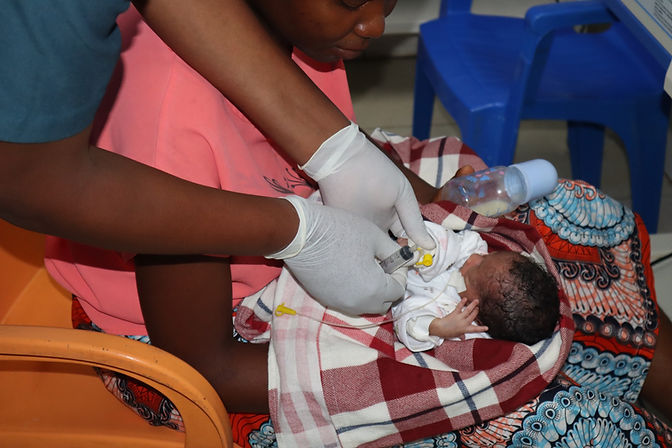
For every 1,000 babies born in Burundi, 21 do not survive their first month. Most of these deaths are caused by birth asphyxia, prematurity, and infections—conditions that are 100% manageable with the right equipment and personnel.
HOW WE CHANGE THIS
Dedicated Neonatal Intensive Care Unit (NICU).
Incubators and phototherapy for premature infants.
Qualified midwives trained in emergency neonatal resuscitation.

MEDICAL MASTERPIECE
Hippocrates Hospital of Kajaga (HHK)
Centrally located to serve as a hub for advanced diagnostics and emergency care, HHK reduces "deadly delays" by offering specialized maternity, surgical, and neonatal services in a state-of-the-art facility.
+13,000 children received.
Vital treatments
Medical support
Vaccinations
And much more.
+8,000 women received care
Medical consultations
Obstetric consultations
Gynecological consultations
Assisted childbirth
Family planning services
And much more.
+8,000 treatments received.
Current treatments for AIDS and HIV
Treatments for malaria
Treatments for pneumonia
Treatments for infections
Neurological diseases
And much more.
SYSTEMIC RISK
A lifebuoy in danger of collapsing.
Despite our vital role as a bridge in Burundi, HHK is facing an immediate financial crisis. Demand is exploding as other facilities close, while our resources are dwindling.
Take action


Our integrated healthcare ecosystem
HHK is not just a building; it is part of a multi-channel health response network that goes where no one else goes.
Pharmacy and supplies
Providing essential medicines free of charge to the most vulnerable, including pregnant women and children under five.
-
Medication management in hospitals
-
Free maternal medicine
Mobile clinic
Reaching rural Bujumbura and camps for displaced people where medical personnel and equipment are chronically lacking.
-
Remote consultations
-
Disaster Response
Nutrition
We care for health even beyond the walls of our hospital. We manage several nutrition projects in the country.
-
Awareness projects
-
Food security activities
-
Emergency action

NUTRITIONAL SOVEREIGNTY
Providing care beyond the hospital walls.
We cannot treat a patient only to send them back to face hunger. Our integrated approach to nutrition focuses on:
-
Treatment of severe malnutrition
-
Intensive care for children suffering from acute malnutrition.
-
Community gardens
-
Education for sustainable agriculture to prevent recurrence.
Only 0.1 doctor per 1,000 inhabitants
87 %
of the population lives below the extreme poverty line
≃90 %
of the population relies on subsistence farming
56 %
of children under 5 suffer from stunted growth (chronic malnutrition)
36 deaths
per 1,000 live births